

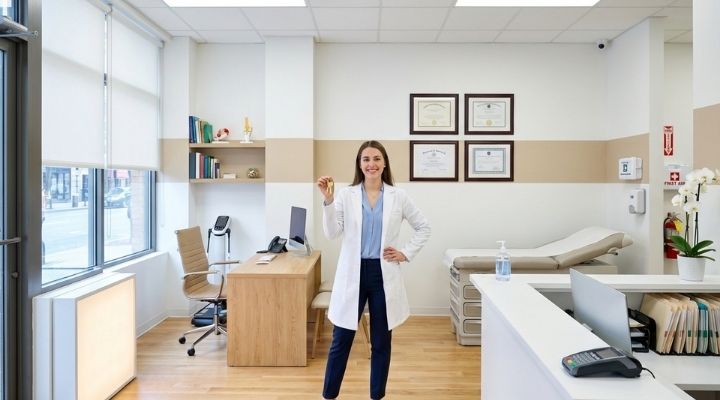
Opening a dietitian clinic requires meeting four core requirements: academic qualification, professional registration, business and tax registration, and compliance of the physical space with health regulations. The process is more than renting an office — it’s establishing a recognized “nutrition consulting center” under the rules that govern healthcare practice in your jurisdiction.
İçindekiler
ToggleWhat Are the Requirements to Open a Dietitian Clinic?
The requirements for opening a dietitian clinic rest on four pillars: academic qualification, professional credential, business and tax registration, and a physical space that meets health regulations. The process starts with completing an accredited Bachelor’s or Master’s degree in Nutrition and Dietetics and obtaining the relevant national credential — RDN through the CDR in the US, RD through the HCPC and BDA in the UK, or the equivalent in your country. From there you register your business, set up tax registration, and apply for any required local health authority permit for your practice location.
Education and Professional Requirement
You need a Bachelor’s or Master’s degree in Nutrition and Dietetics from a program accredited by the body that regulates the profession in your country (ACEND in the US, AfN-approved in the UK, EFAD-recognized in EU member states). The credential must be current and verifiable — this is the first and most critical condition for legally accepting clients. Master’s-level qualifications and doctoral degrees aren’t required to open a clinic, but they support topical authority and let you formally specialize (oncology nutrition, sports dietetics, eating disorder recovery, etc.).
Business Setup
You’ll need to establish a tax-registered business entity. Most new dietitians choose a sole proprietorship or single-member LLC for the lower setup cost and simpler administration. In the US, this means filing the appropriate state business registration and obtaining an EIN from the IRS. In the UK, register as self-employed with HMRC or set up a limited company. In the EU, register with the local commercial registry and obtain a VAT number. Working with an accountant or bookkeeper from day one makes invoicing, sales tax/VAT, and self-employment tax filings significantly easier.
Health Authority Permit
To formally open the clinic, you’ll need to register with the relevant local or regional health authority. Required documentation typically includes proof of professional credential, criminal background check, proof of address, and architectural drawings of the clinic space. Inspectors visit to verify that the physical space meets the published standards for healthcare consulting facilities. Once approved, the operating permit must be displayed in a visible location within the clinic.
What Are the Physical Space Requirements?
The physical space requirements cover client privacy, hygiene standards, and accessibility for people with disabilities. The clinic can be located in an office building or a standalone unit; if you’re operating in a residential building, you’ll typically need explicit written consent from the building’s other owners or management. Floors should be made of easy-to-clean (antibacterial) material, and lighting should be in the comfortable working range (300–500 lux average).
Consultation Room Size
The consultation room should be between 10 and 15 m² (approximately 110–160 sq ft). This gives enough room for the dietitian’s desk, the client chair, and a body composition analyzer (BIA), with comfortable circulation space. A handwashing sink in the room is critical for both hygiene compliance and the permit process. Rooms with a window for natural ventilation, and adequate sound insulation to protect client privacy, are strongly preferred.
Waiting Area
A comfortable waiting area of at least 10 m² (~110 sq ft) should be available for clients between appointments. Plan seating at roughly 1.5 m² per person, and include a stand for current health publications or informational brochures. A small refreshment corner with water and healthy snacks improves the client experience and is increasingly the standard expectation in modern wellness practices.
Accessibility
The clinic must be designed to accommodate people with disabilities — entry, movement throughout the space, and restroom use. The basic criteria are: wheelchair-accessible building entrance (ramp or level access), elevator wide enough for a wheelchair if not on the ground floor, and no door thresholds. Internal corridors should be at least 120 cm wide, and the accessible restroom should meet local accessibility standards (ADA in the US, Equality Act / BS 8300 in the UK, equivalent in EU).
Building Systems
Heating, cooling, ventilation, and plumbing should all function reliably. Central heating or efficient HVAC for cooling, with hot/cold water supply for the consultation room sink. Electrical wiring should be properly grounded to protect medical devices (professional scales, BIA units), and an uninterruptible power supply (UPS) is recommended for critical equipment.
Required Documentation
- Notarized copy of degree or diploma
- Photo ID
- Recent passport-style photographs (if required for permit application)
- Criminal background check
- Signature specimen (for business banking and official documents, if required)
- Lease agreement or property deed
- Fire safety inspection certificate
- Municipal business operating license
- Medical waste disposal contract (if required by your local health authority)
What Should a Dietitian’s Office Have?
A dietitian’s office is judged by the precision of its technology and the professional equipment that ensures client comfort. Good equipment supports not only accurate measurement but also evidence-based interpretation of the data.
1. Professional Body Composition Analyzer (BIA)
The heart of the clinic is a professional Bioelectrical Impedance Analysis (BIA) scale. These devices report body fat percentage, muscle mass, visceral fat, edema level, and basal metabolic rate (BMR) with accuracy approaching 98%. Medical-grade models from Tanita, InBody, or Seca are the practical choices. A built-in reporting feature is critical — visual progress graphs are one of the most powerful client motivation tools.
2. Anthropometric Measurement Set
Beyond the BIA, classical measurement tools remain the “gold standard” benchmark. The essentials:
- Tape measure: Non-stretching steel or plastic tape for waist, hip, and neck circumference measurements.
- Skinfold caliper: For skinfold thickness measurements that identify regional fat distribution.
- Stadiometer: Wall-mounted or scale-integrated, for precise millimeter-level height measurement.
3. Software and Tracking Systems
A clinic seeing 10–15 clients a day cannot operate efficiently on paper files. Practice management software designed for dietitians should include:
- Food intake logging with macro and micronutrient analysis.
- Appointment reminders (SMS / WhatsApp integration).
- Integrated video conferencing for online consultations.
- Client portal for sharing meal plans and lab results securely.
4. Office Furniture and Ergonomics
For long consultation sessions, the dietitian’s chair should have lumbar support and proper ergonomic design. Client chairs should be firm enough to feel professional but comfortable enough to put clients at ease. The consultation desk should have room for both computer use and showing visual materials (food models, portion guides) to the client.
5. Educational Materials and Food Models
Real-size food replicas should be used to teach portion control. Visualizing what one portion of meat, bread, or fruit looks like increases client compliance by 30–40% according to behavioral nutrition research. Glycemic index charts, seasonal fruit and vegetable calendars, and “balanced plate” model posters work well as wall-mounted educational pieces. A kitchen scale should also be on hand for portion-control demonstrations.
